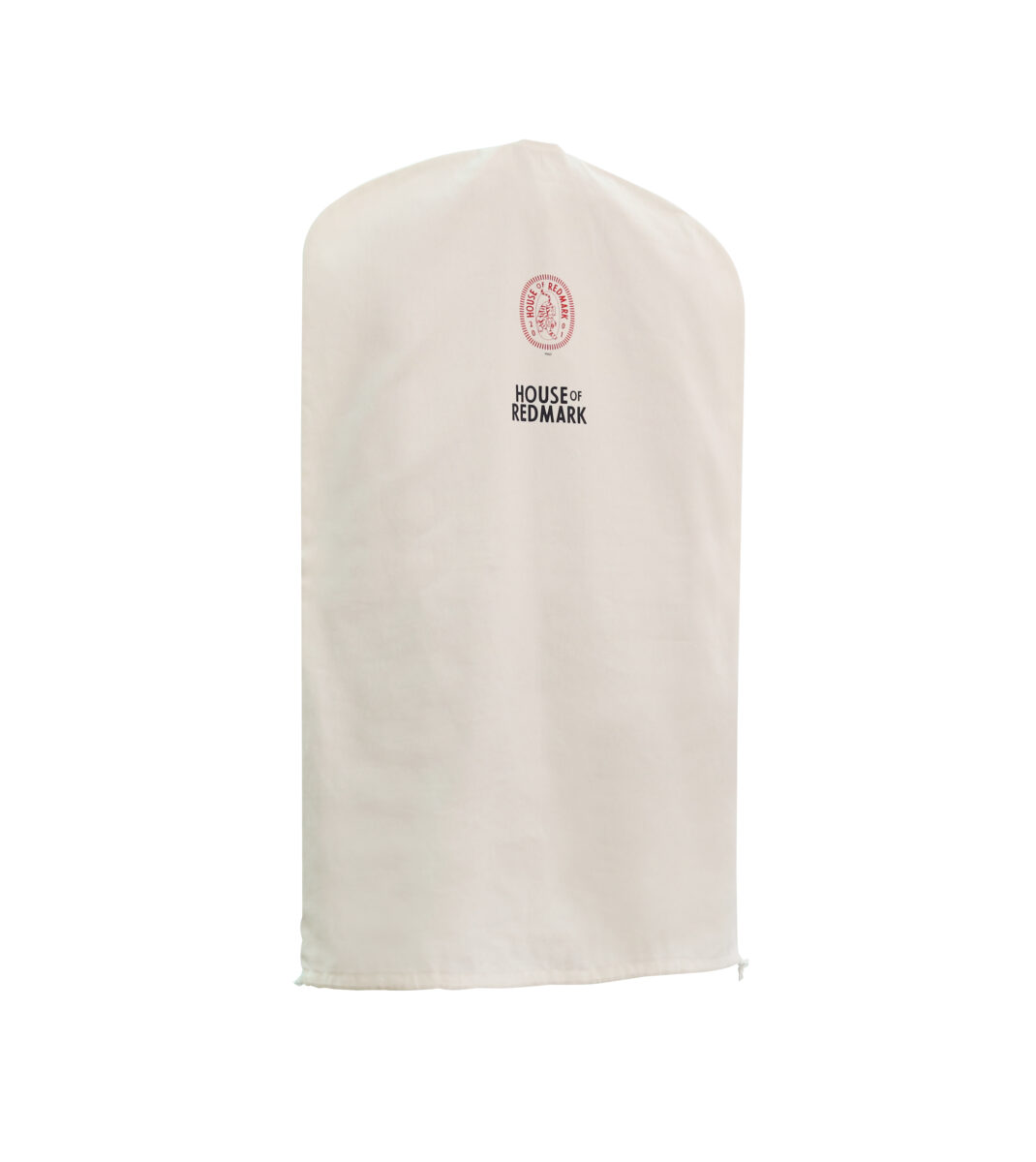
Custom garment bags are fabric covers that protect jackets, dresses, coats and suits from dust, light and moisture, while carrying the brand’s logo and colours. They are a packaging element that travels with the garment from the showroom to shipping, all the way to the customer’s wardrobe. Redmark produces them made to measure in Italy in cotton, nylon, non-woven fabric, satin and organza, in versions for garments, with handles and for trousers, customisable front and back.
If you are looking for custom garment bags for an atelier, a fashion brand, a tailoring workshop or your fashion e-commerce, the choice depends on the material (look and level of protection), the type of garment to protect and how you apply the logo. Below you will find how to navigate this, with a materials table and the most frequent questions.
What are garment bags
A garment bag (also called a garment cover or clothing cover) is a cover that wraps a garment on its hanger and protects it from dust, rubbing and moisture. Compared with a plain cover, a custom garment bag also becomes a communication tool: printed with a logo and graphics, it travels with the garment and reinforces brand recognisability at every step.
The difference between the terms is mostly about usage: “garment bag” and “garment cover” are the most common in professional and tailoring contexts, while “clothing cover” is a more general description.
Redmark garment bag materials
The material determines the aesthetic result, the level of protection and how the brand is perceived. Redmark makes garment bags in five materials.
Cotton is the most premium and breathable choice, ideal for valuable garments, wedding dresses and tailoring. Non-woven fabric (TNT) is practical, light and cost-effective, suited to volumes and everyday protection in the warehouse and in shipping. Nylon is strong and light, with good protection against moisture. Satin gives a soft, precious effect for high-end garments. Organza, semi-transparent and refined, lets the garment show through and is perfect for premium packaging.
Materials comparison table
| Material | Characteristics | Ideal use |
|---|---|---|
| Cotton | Breathable, elegant, reusable | Wedding dresses, tailoring, valuable garments |
| Non-woven fabric (TNT) | Light, cost-effective, protective | Warehouse, shipping, high volumes |
| Nylon | Strong, light, good moisture barrier | Frequent use and travel |
| Satin | Soft and precious | High-end garments, premium packaging |
| Organza | Semi-transparent and refined | Premium packaging, garments to display |
The three versions
Redmark makes three constructions, all with a customisable format and front-and-back customisation:
- Garment bag: the classic cover for jackets, dresses, coats and outerwear.
- Garment bag with handles: designed for transport, with handles to carry the garment comfortably.
- Garment bag for trousers: a format dedicated to trousers and suits, with a construction suited to the fold.
The construction — including the format and the closure (typically a central zip) — is customisable according to the garment and the use.
How to choose the right garment bag for your use
Beyond the material, context matters. For ateliers and tailoring, cotton communicates craftsmanship and protects made-to-measure garments. For wedding and ceremony dresses, cotton and organza combine protection with an elegant presentation. In showrooms, the custom garment bag keeps garments tidy and consistent with the brand image. For garment shipping and fashion e-commerce, non-woven fabric and nylon protect during transport and improve the unboxing experience. For travel, the version with handles makes carrying easy.
Customisation: printing, embroidery and labels
The Redmark garment bag is customisable front and back with the brand’s logo and graphics. Available techniques include printing, embroidery and applied labels, chosen according to the material and the desired effect. Customisation can cover the fabric colour, logo, text and details, for a result coordinated with the rest of the packaging.
Reusable and sustainable garment bags
A garment bag in cotton, nylon or satin is designed to last and to be reused, unlike single-use covers in light plastic. A garment protected by a quality cover lasts longer, and a reusable cover with your logo keeps circulating and showing the brand over time. It is a concrete way to combine protection, image and attention to waste.
Minimum quantities, lead times and production
Minimum quantities depend on material and finishing. Redmark also works on small runs, useful for brands that want well-made covers without ordering large volumes, as well as on higher quantities. Lead times vary with customisation, finishes and quantity: for an accurate estimate, the best route is a request with the project specifications (garment to protect, material, quantity, type of logo).
Garment bags as part of coordinated packaging
A garment bag performs best as part of a consistent system. Coordinating it with dust bags, shopping bags, boxes, pouches and labels of the same brand creates a recognisable experience, from the store to shipping to the customer’s wardrobe. This is the advantage of a single manufacturer: materials, colours and finishes aligned across every element. → See also: Dust bags · Shopping bags · Boxes · Labelling (link to the corresponding EN pages)
Why choose Redmark
Redmark is an Italian company producing packaging and accessories for fashion and retail, based in Carpi (MO), in the heart of the Italian textile and fashion district, active since 2001 with an approach that combines design, research and production. It does not resell off-the-shelf products: it designs and makes garment bags, dust bags, shopping bags, boxes and labels to measure, following the brand from material selection to finishing. That means control over quality, consistency across packaging elements and customisation a standard cover cannot offer.
Frequently asked questions

